
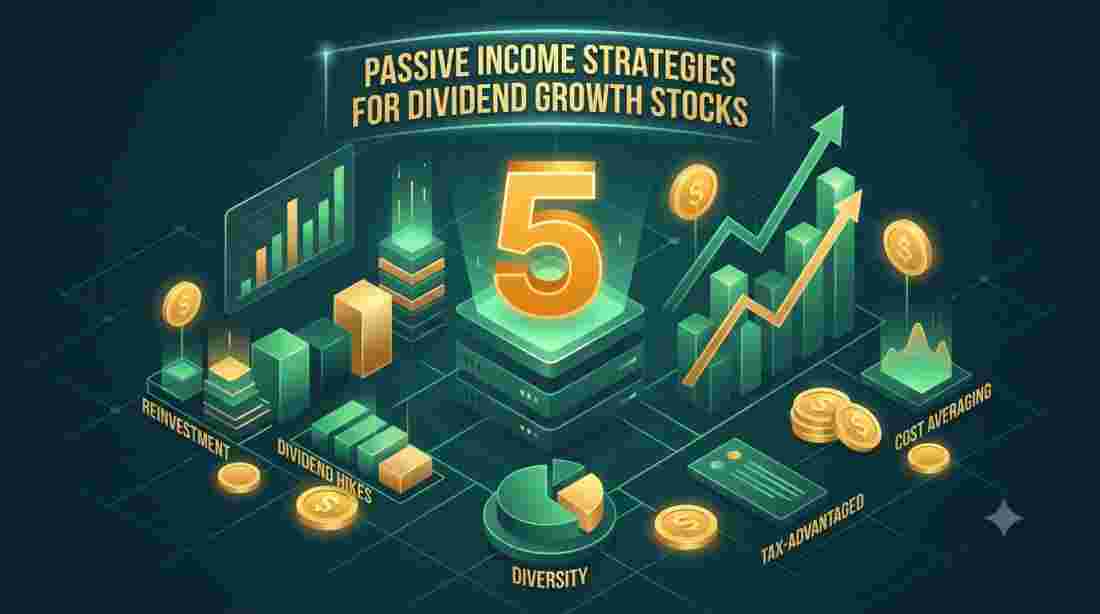
5 passive income strategies for dividend growth stocks
5 passive income strategies for dividend growth stocks is a key metrics to help guide you on how to make better investments chouces and sharpen your skills.
when was the last time you looked up your stock portfolio? Can you keep track of how many of your shares pay out dividends? Or what sector they belong to?
The natural dividend yielding procedure is to add some very vital or consumer stocks in your portfolio. The very vital issue is that these typical dividend-paying sectors may fare poorly when they want to raise interest rates. Some of the investors who reduce the rate at which they invest into these potential investments tend to miss out on great deals and impressive growth rate.
Related articles on smart investment
5 ways you can improve on your investment strategy.
DON’T GO JUST TO LOOK FOR HIGHEST YIELDS:
Most investors tend to buy more on higher yield stocks, which later look expensive or become more expensive eventually. But instead of relying solely on high yield stocks, income-focused fund managers go for new potential future dividend growth. Some of the high potential dividend growth sectors are technology, energy and materials, compared to the much known utility sector. So this 5 passive income strategies for dividend growth stocks will boost your investor confidence.
Related articles on smart investment
INVEST IN COMPANIES THAT ARE RESTORING THEIR PAYOUTS:
How do we mean by “companies restoring their payouts”, this is actually a long term strategy that tend to reward you over time using compound interest and higher dividend yield growth over time.
INVEST YOUR MONEY IN COMPANIES THAT ARE RESTORING THEIR PAYOUTS:
This can be a highly profitable long-term strategy; most investors have been purchasing higher yield stocks, which will result in making the price of the stock to become even more expensive. Rather than pay more attention on high current yields, income-focused fund managers look for future dividend growth. Most sectors that offer better dividend growth potential are technology and finance.
Related articles on smart investment
If you buy shares that pay a small dividend, the yield on your initial investment may skyrocket if the firm boosts the rate. Rebuilders formerly paid high dividends, so you can be certain that management will share the wealth when they’re able. A lot of financial firms are increasingly developing fast. Apply this 5 passive income strategies for dividend growth stocks and be financially free.
KEEP AN EYE OUT FOR FIRST-TIMERS:
Most new startups or IPO tend to sound more positive in their first year of business; this can drive investors interest and raise a high dividend yield due to investors interest in the project and the growth potential of the company provided the framework remains solid.
For example Apple started paying a dividend as recently as 2012. Just know that dividend usually comes with its own cost. Sometimes it means that a company’s growth has either deteriorated or their was lower yield in profit and so in turn may look good for investors provided insights are showing future progress and long term growth potential. Then for investors there is no cause for too much panic as investment comes with risk but manageable risk yields better investment profit.
CAUTIOUSLY VENTURE OVERSEAS:
Foreign stocks are more prone to granting higher profitable dividend yields than U.S. companies. I’m as surprised as you are but that is the current reality. Taxes withholding of up to 10-20 percent on all dividends paid to U.S. shareholders tend to make investors panic before buying into any US investment. You can recover that money through the process of foreign tax credit if you hold the shares in a taxable account, but not if you hold the shares in an IRA or other tax-deferred account.
IN ADDITION:
Avoid “Overpayers” Sometimes a company’s dividend is too good to be true. If a company pays out huge amount of its earnings mostly in two quarters of the year to increase or maintain its dividend, they tend to leave themselves little or no earnings to generate future growth. We need to compare the dividend payout ratio of companies and be aware of those paying out 70, 80 or even over 100 percent of their earnings.
How about we consider a dividend-focused fund instead of randomly selecting stock we deemed fit best. Some funds focus on higher yields, while others look for more moderate yields with future dividend-growth potential, the two approaches will most likely have very different portfolios. So knowing which strategy you’d rather pursue high current yields or future growth will help to position better in the choice of stock to pick.
How passive income from dividends works.
Passive income is when we grow income without actively investing our time and energy. Best case, this is “Do nothing and earn money at the same time”.
It is therefore in contrast to active work, for example employment in a company or self-employment. Even professional traders who work with “earn money day trading” or through trade options usually work actively.
It goes like this: work = money, and unfortunately also, no work = no money.
In plain sight we can say that passive income is very attractive. But usually seen as very difficult to realize.
The following are ways one can generate such income:
- Rental and leasing income from real estate holdings.
- Income from licenses, rights, royalties and intellectual property for example, books, music, photos or software that you have produced or to which you hold the rights and for which you remunerate users.
- Solar plants, wind power plants and other productive property.
- Positions and offices that require no or only minimal work and for which there is remuneration.
- Automated products and business activities that customers can purchase and use without your intervention. For example, online courses and seminars created by you.
- Dividend stocks: Interest from investments or the coupons on bonds are a proven source of passive income.
With all these mentioned above, it is quit debatable that whether the income is really completely passive. Most times the forms are evaluated based on active work that was only carried out for a limited period of time and subsequently generates profits for a longer period of time.
The statutory pension is theoretically also counted as passive income, as people work first and then receive regular payments without any active involvement.
Even with capital-based income such as dividends the definition below can be related to it, it goes as: money always represents work (the proportion / significance of which is still disputed in economics to this day). Accordingly, the capital with which we earn dividends is ultimately also work – just performed at a different time or by different people.
So we can say that: passive income is the income that is not generated directly through active work.
Dividends, the best source of passive income?
Many of the real ways to make money passively are not all that clear in plain sight! You need in-depth research and a bit of luck too. The only reliable source of income that can function permanently and without active intervention are investments.
These include:
- Dividends and other profit-sharing (e.g. silent partnership in a company).
- Rental and leasing income.
- Coupons (interest that you receive by investing in bonds).
Dividends no matter how little can be earned provided you have a little or huge quantity of a particular share of a stock be it in technology, finance, real estate, energy, manufacturing, agriculture etc.
Another advantage is that the rules for a lucrative dividend portfolio can also be applied to fixed-interest products, short-term bonds and the like.
How to apply the dividend strategy correctly
Passive income from dividends is easy to understand, but not quit easy to master, you need constant dedication and zeal in order to get the best out of it. Some companies distribute part of their profits, known as dividends, to their shareholders. If you own shares in such companies, you will also receive a corresponding payout.
You need to accumulate such securities in order to yield profits as passive income.
There are three main types of investment for this purpose:
- Dividend starke Aktien: the “Classic” for a dividend strategy are shares in companies that offer an attractive payout. Investors who follow a dividend strategy buy these securities directly through their broker.
- Distributing ETFs and Investment Fund: These are packages of several dozen to thousands of securities. If you invest in such products, you acquire shares in all the stocks they contain. Among the large selection, you will also find offers that focus on dividend payments and offer regular distributions.
- REITs: represent a special form of shares. These are real estate companies that are active in the rental, leasing and related fields. They benefit from extensive tax advantages, but in return have to distribute almost all of their profits to their investors. This can make them very attractive investments for a dividend portfolio.
Bonds are often found in the portfolios of investors seeking passive income. These exchange-traded loans for companies or governments are remunerated with interest (the so-called coupon). Despite the different names, the function is comparable to dividends.
Investors should be aware that building up a passive income has a considerable demand on the broker with what it provides. You need a provider with an extensive range to put together the right securities, bonds, ETFs and more! Unfortunately, the product catalogs of simple app brokers can only serve as a basis, but then quickly reach their limits.
Final thoughts
Generating passive income using dividend growth stock is the way to go. You need to be smart in accumulating the right stocks and maintain a high level of discipline in order to see significant result while your portfolio grows.
Key takeaways:
- Focus on Dividend growth over initial yield.
- Automate with a Dividend Reinvestment Plan (DRIP)
- Monitor the payout Ratio
- Watch key dates etc.
Your road to financial success has just begun.
Related links:
- How to allocate portfolio on your investments
- how to turn $1 to $1 million dollars
- How to make money on online from home
- How to make money as a teenager
- How to clip videos on YouTube