
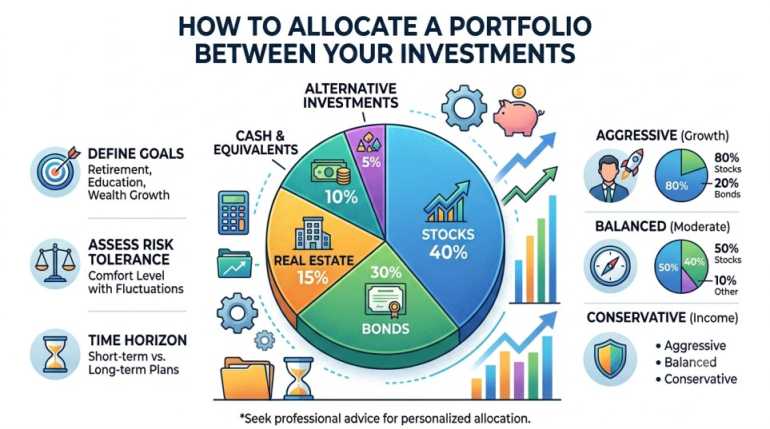
How to Allocate Portfolio on your Investments
Introduction
How to allocate portfolio on your investments. Firstly, I would like to officially welcome you to financial freedom.Firstly, I would like to officially welcome you to financial freedom. Everything you learn here will give you all the tools you need to be financially free.
What is a portfolio?
A portfolio is a set aside stock, cash or liquidity designed by the investor to put into assets or investments in order to get daily/weekly/monthly or yearly returns.
A portfolio can come as a whole or diversified. What do I mean? As a whole I mean that it can be intended to put out into a particular stock or a crypto investment or into real estate and housing provided it is not diversified.
Now what is diversification?
This is the process of splitting your portfolio into micro parts to accommodate a variety of investments assets to be invested in.
So back to the topic: How to allocate a portfolio on your investments. Here are steps to a better decision making:
You need to check your priority:
You need to weigh the risk to reward, this will enable you to know which assets deserve more allocation than the other. To know your priority you need to know what the long term plan of your strategy is like, the pros and the cons, the level of the level of uncertainty and your future goal.
If you are looking at holding more fixed stable cash in local currency but still want to be earning interest on those investment and if you feel whether you feel safer with it, this is a good reason to consider before embarking on the plan.
If you prefer to leave your funds hanging in a lever investment to beat inflation provided there is a higher dividend returns then you need to consider your strategy to accommodate it perfectly.
You need to change how you think:
If you are investing 100 dollars (USD) into an asset and expect to receive 3x or even 10x of that investment in a short period of time, you need to change that mindset. Investment usually takes long years to compound for you to be able to see the reward of your investment. Rewards of investments are usually sweet when they compound over time.
Imagine you want to be financially free and you invest 100 USD from your monthly pay check of 150 USD into in assets that yield for you over time a 15% interest and the assets value appreciates to about 1000% over the next 10 years with an average of 50% to 100% every year, you will discover that your 100 USD invested over 10 years would be worth an equivalent of $138,000 USD plus with an average of 2,000 USD monthly income. This is the power of compound interest.
What is compound Interest?
This is interest gotten from an investment and it is reinvested to gain more. For instance if you invest $100 to get $110 at the end of the year and you get to reinvest that $110 the following year will be like 112USD now if everything gets reinvested year in year out you will see the power of compound interest.
Knowing and investing so your money can work for you:
How do you plan to retire, at what age do you intend to retire, what are your future plans for retirement; you cannot have all this things in your head if you are not planning towards retirement. If you don’t plan for retirement then expect the opposite. No job is a permanent job, you need to buy back your time by buying assets that are deflationary with high dividend payout or that have a high upside growth potential chances over time.
How do you get this information?
The answer is as simple as it goes, you make research. Research has proven to be the only source of self-truth, as the crypto community will call it; DYOR (Do your own research) like you are doing now. One of the benefits is that it helps to build and solidify existing conviction on a particular asset or group of highly profitable assets. It also helps you to know the new developments about that particular asset to be on the know for future development, this can also help to increase your investment allocation and high trust level and conviction.
Conviction is a key in investment. It helps to keep you mentally at peace. Investments come with a lot of mental stress. This stress gives from allocating money you know fully well could have gotten you a short term pleasure, to the risk of investing so much money into an assets that could crash one day or the stock price giving significant issue or the broker going insolvent overnight. All this can cause you a hell of a headache. But when you do appropriate research and investment, these risks and fears are reduced drastically. When investment, these are key metrics you need to pay attention to.
They include:
- The Brokerage firm/to which you are buying your stock/assets.
- The level of risk you can take.
- Patience and Perseverance.
The Brokerage firm/to which you are buying your stock/assets:
This is a careful subtopic to digest properly. When registering a platform for a to a platform, exchange or broker in order to acquire an assets or stock you need to pay close attention to the email you are using to create that account, the password created for that account has to be familiar or stored somewhere for future reference purposes. When purchasing a stock make sure to use your CHN or CSCS for future claims in case the broker becomes inactive in the future you can still trace and withdraw your stock from the Central Bank. Security of investment is a key area most investors neglect and tend to which is the most vital aspect in investment.
So therefore, it is very important to secure your investment one time in order not to incur loss of access to assets.
The level of risk you can take:
You need to know the level of risk you can take. Taking risk they say is a step to knowing what is unknown and beating your fear. Taking no risk at all is a risk so whether you take risk or not it’s still a choice that is risky. But the idea is that, the risk you are taking how beneficial is it to you.
What do you stand to gain in taking risk? What is the reward attached to this risk, these are all positive questions that need to be asked before embarking on acquiring an assets. You need to know if that asset is actually an assets and not a liability. You need to do research, by research, I mean proper research.
This helps you not to chase trends and hypes that may result in buying circle tops. When you do proper research it increases your confidence level towards all that assets.
Patience and perseverance:
You need to allow the market absorb you and and play out in a way that will favour you. Let me tell you this one thing about the market, the market has a heart like human, but it does not have emotions, so what drives its heart beat? The thing that drives its heart beat is your liquidity; this liquidity enables it to breath and absorb your true intentions. With bright knowledge in technical analysis you can have an edge on the market although I won’t advise to use technical as a key metrics to invest but best you use Dollar-cost averaging (DCA).
What is DCA (Dollar Cost Averaging)?
Dollar cost averaging is a system of investing that has to do with buying stocks or assets more when the stock / asset price is low and fewer when the asset price is high. So that when the asset increases in price your share value increases and when the stock price drops the volume of price drops in value of your share purchased at a higher price will be minimal.
So therefore the best way to allocate portfolio between tech and consumer finance all relies on your financial knowledge about that particular asset. If I say to you that tech is a better option and you have less tech skills and knowledge I may or may not be wrong. It all falls back to doing proper research on that particular asset. If you want to invest in stocks that are tech based, learn more about tech stock and look for top selling stock assets that have consistent progress over the years with higher yield that compounds over time.
But if you are looking to invest in consumer finance which is another profitable niche to invest in, such as manufacturing, production companies you need to dive deep on our articles to learn more on this projects and companies.
Final thought
Investing is a key to financial freedom. Every saver sit back in the bank or at home thinking that saving is investing, I’m sorry to disappoint you, saving is not investing. Investing comes with a more strategic approach where you have your money working for you provided you have a working system while saving is all about putting money in an account and accumulate over time provided you keep putting money inside. Investment comes with risk but with a proper approach as discussed in this article I believe you have understood the best practices needed in order to be a successful investor.
In Conclusion
Know your risk appetite and invest accordingly based on the knowledge acquired on that particular project or group of assets.






great work. keep it up. i love the content
Thanks so much