
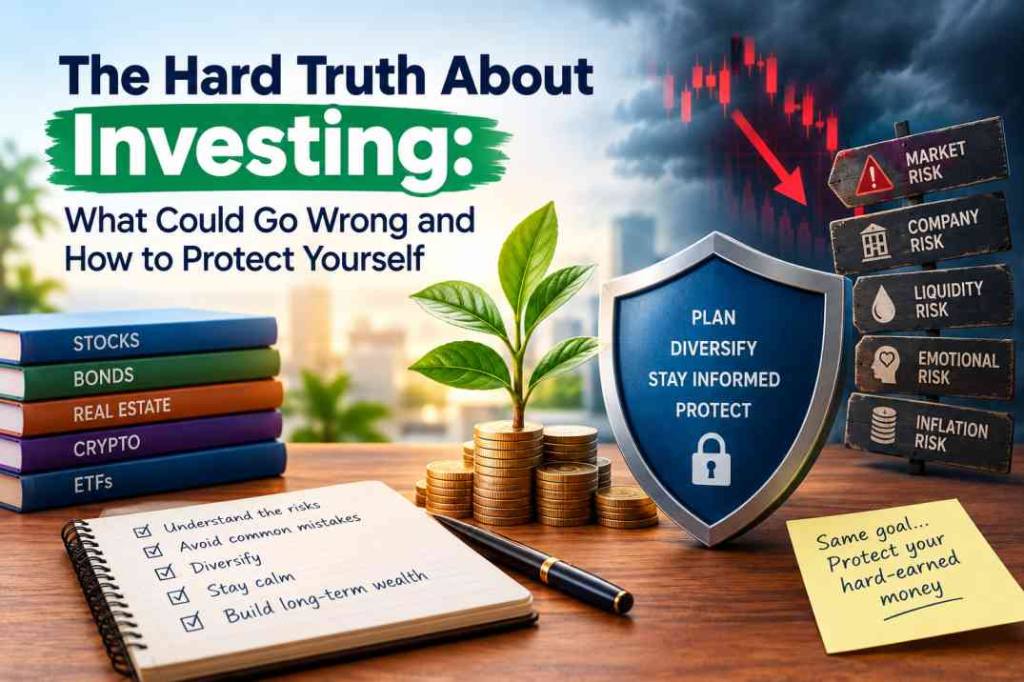
The Hard Truth About Investing: What Could Go Wrong and How to Protect Yourself
Investing involves opportunities, but it also comes with risks. Learn about the major investment risks, common mistakes, and practical strategies that can help you protect your money and make informed financial decisions.
You have started building your investment portfolio. Perhaps you are buying stocks, investing a fixed amount every month, or putting money aside for your long-term financial goals.
Watching your portfolio grow can be exciting. You may begin to imagine what your investments could become in five, ten, or twenty years.
But there is an important reality every investor needs to understand: the stock market does not always go up.
Investment prices can rise, fall, and remain stagnant for extended periods. Even a promising company can experience setbacks, and a well-diversified portfolio can lose value during a market downturn.
Investing can help you build wealth over time, but it does not guarantee a profit. Depending on what you invest in, you could lose some or all of your original capital.
That is why successful investing involves more than choosing stocks that might increase in value. It also requires understanding risk, managing expectations, and preparing for unexpected events.
In this guide, we will examine the major risks investors face, common mistakes that can damage a portfolio, and practical ways to approach investing more responsibly.
What Is Investment Risk?
Investment risk is the possibility that an investment will produce a different result from what you expect, including the possibility of losing money.
Different investments carry different risks. Shares can lose value when a company’s performance deteriorates or market conditions change. Bonds can be affected by interest rates and the issuer’s ability to repay its debt. Real estate can lose value or become difficult to sell. Cryptocurrency prices can fluctuate dramatically.
Even cash has a potential drawback: inflation can reduce its purchasing power over time.
The level of risk you can reasonably accept depends on several factors, including your financial situation, investment goals, time horizon, and ability to withstand losses.
For example, someone saving for a house deposit next year may need to prioritise stability and access to their money. Someone investing for retirement several decades away may have more time to tolerate market fluctuations, although their individual circumstances still matter.
The important lesson is that risk itself is not necessarily a reason to avoid investing. Instead, you need to understand the risks you are taking and determine whether they are appropriate for your circumstances.
The US Securities and Exchange Commission’s investor education resource explains how investment choices should reflect factors such as time horizon and risk tolerance.
Five Types of Investment Risk Every Investor Should Understand
1. Market Risk
Market risk is the possibility that an investment will lose value because of broader market conditions.
Stock prices can fall because of economic slowdowns, inflation, changing interest rates, geopolitical events, weaker business expectations, or declining investor confidence.
During a market downturn, even financially sound companies can experience falling share prices.
Imagine that you own shares in a bank. The bank continues serving customers and generating revenue, but concerns about the wider economy cause investors to sell stocks.
Your shares could decline even if the bank’s underlying business remains relatively stable.
However, you should not automatically assume that every falling stock will recover. A price decline may reflect temporary market pressure, but it can also indicate a serious problem with the company.
How can you manage market risk?
- Choose investments that fit your financial goals and time horizon.
- Diversify across appropriate investments rather than relying on one company.
- Avoid investing money you will need for essential expenses soon.
- Understand that market prices can fluctuate significantly.
- Review the reasons for a decline instead of reacting immediately to fear.
Market declines are a normal feature of investing. Your response should depend on your financial plan and the circumstances affecting your investments, not simply on the colour of your portfolio balance.
2. Company-Specific Risk
Company-specific risk arises when something affects an individual business or a particular investment.
Possible causes include poor management decisions, excessive debt, declining sales, stronger competition, regulatory problems, or unexpected operating costs.
For example, suppose you invest in a company because its share price has been rising. Later, the company reports declining revenue, increasing debt, and weaker cash flow.
These developments may indicate that the business is struggling, even if the wider stock market remains strong.
This is why researching a company matters before buying its shares.
Consider the following questions:
- How does the company make money?
- Are its revenue and profits growing?
- How much debt does it carry?
- Does it generate cash consistently?
- What competitive advantages does it have?
- Who manages the business?
- What could threaten its future performance?
- Is its share price reasonable relative to its financial performance?
No single indicator can tell you whether a stock is a good investment. However, examining several aspects of a business can help you understand what you are buying and the risks involved.
Remember that buying a share means acquiring an ownership interest in a company. It is not simply a bet on whether its price will rise tomorrow.
3. Liquidity Risk
Liquidity risk is the possibility that you will be unable to sell an investment quickly at a reasonable price when you need the money.
Some investments trade frequently, with many buyers and sellers. Others trade less often, making it harder to find a buyer at your preferred price.
For example, shares in a small company may have limited trading activity. If you suddenly need to sell a large holding, there might not be enough buyers at the current quoted price.
You may have to wait or accept a lower price.
Liquidity also matters when choosing between investments such as publicly traded shares and certain property investments, which can take considerable time and money to sell.
How can you manage liquidity risk?
First, keep money for essential expenses separate from your long-term investments.
If your rent is due next month, that money should not be exposed to substantial short-term market fluctuations.
Second, understand how easily an investment can be sold and whether selling it involves fees, restrictions, or significant price concessions.
Third, maintain an emergency fund appropriate to your circumstances. This can reduce the likelihood that an unexpected bill will force you to sell investments at an unfavourable time.
Your investments should support your financial plan, not leave you unable to pay your immediate expenses.
4. Inflation Risk
Inflation reduces the purchasing power of money when prices rise over time.
Imagine that you have ₦100,000 in a savings account. The balance remains ₦100,000, but the cost of food, transport, housing, and other necessities increases.
Your balance has not changed, yet it may buy fewer goods and services.
This is why investors often consider the return on an investment alongside inflation.
Suppose an investment earns 8% over a year while inflation is 12%. Ignoring taxes, fees, and other complications, the investment has failed to preserve purchasing power.
The approximate real return is:
Real return ≈ nominal return − inflation
In this example:
8% − 12% = −4%.
The exact real return is calculated by dividing one plus the nominal return by one plus the inflation rate, then subtracting one. In this case, the real return is approximately −3.57%.
This illustrates an important point: a positive nominal return does not necessarily mean that your money has grown in purchasing-power terms.
However, investing does not automatically protect you from inflation. Stocks can fall, property values can decline, and some other investments may also deliver returns below inflation.
How can you approach inflation risk?
- Compare the expected return of an investment with inflation.
- Consider the effects of fees and taxes on your returns.
- Avoid assuming that an asset will always rise in value.
- Choose investments according to your goals and ability to tolerate losses.
- Review whether your savings strategy remains appropriate as living costs change.
Your objective should be to understand how your money may perform in real terms, rather than focusing exclusively on the balance displayed in your account.
5. Emotional and Behavioural Risk
Sometimes, the biggest investment mistakes arise from how people react to market movements.
Fear, excitement, impatience, and the desire to follow other investors can influence financial decisions.
Consider a stock that rises sharply over several weeks. People on social media begin sharing their profits, and you feel that you are missing an opportunity.
You buy without researching the company or considering its valuation.
Then the share price falls, and you sell because you are afraid of losing more money.
You may have bought at an inflated price and sold during a decline without understanding the investment’s underlying prospects.
This behaviour is sometimes associated with the fear of missing out, commonly known as FOMO.
Other behavioural mistakes include panic selling, excessive trading, and holding a losing investment simply because you do not want to accept a loss.
How can you manage emotional risk?
Create an investment plan before committing your money.
Write down why you are investing, what risks you are willing to accept, and the circumstances that would cause you to reconsider an investment.
Avoid making major decisions solely because of social media excitement or short-term price movements.
It is also useful to limit how frequently you check your portfolio if constant monitoring causes you to make impulsive decisions.
The objective is not to eliminate emotion. It is to prevent emotion from replacing careful reasoning.
Seven Investment Mistakes That Can Damage Your Portfolio
Understanding investment risks is important, but so is recognising the mistakes that can make those risks more damaging.
1. Chasing Investment Hype
You may encounter claims that a particular stock, cryptocurrency, or other asset is about to make investors wealthy.
Someone might show a screenshot of a large profit or claim that an investment will increase dramatically in value.
Such claims can create pressure to invest quickly.
However, a rising price does not establish that an investment is fairly valued or likely to continue rising. By the time an opportunity becomes widely discussed, its price may already reflect high expectations.
Popular investments can still perform well, but popularity alone is not a reliable reason to buy.
Before investing, research the underlying asset, consider its valuation where applicable, and identify the risks that could cause its price to fall.
Never invest simply because you are afraid of missing out.
2. Investing Without Research
Buying an investment without understanding it can expose you to risks you have not considered.
For example, you might buy shares in a company because a friend recommends them, without knowing that the company has substantial debt or declining earnings.
You do not need to become a professional financial analyst before making an investment. However, you should understand the basic characteristics of what you are buying.
For company shares, this could include the business model, financial performance, debt, competitive position, and valuation.
For a bond, it could include the issuer’s creditworthiness, interest payments, maturity date, and sensitivity to interest-rate changes.
For a savings product, it could include the interest rate, fees, access restrictions, and applicable deposit protection.
The research required depends on the investment.
A useful rule is to avoid committing money to something you cannot explain in basic terms.
3. Trading Too Frequently
Frequent buying and selling can increase transaction costs and encourage decisions based on short-term price movements.
Suppose you regularly buy and sell investments because you expect to profit from every small market movement.
Even if some trades are profitable, fees, taxes where applicable, poor timing, and emotional decisions can reduce your overall results.
Frequent trading is not automatically wrong, but it requires a suitable strategy, an understanding of the risks, and the ability to manage costs.
Long-term investors generally have different objectives from short-term traders.
If your goal is to build wealth over many years, consider whether each trade supports your investment plan or simply reflects a reaction to market noise.
4. Failing to Diversify
Diversification means spreading your investments across different assets to reduce dependence on any single investment.
Imagine that your entire portfolio consists of shares in one company.
If that company suffers a major setback, your portfolio could experience a substantial loss.
Holding shares in several companies can reduce the effect of problems affecting any one business. Diversifying across asset classes, industries, or markets may reduce other concentrations of risk.
However, diversification does not eliminate all investment risk.
Several investments can fall simultaneously, particularly during periods of broader market stress. Furthermore, owning several funds or stocks that hold essentially the same assets may provide less diversification than you expect.
The goal is not to collect as many investments as possible. It is to build a portfolio whose overall risk is appropriate for your objectives.
The SEC’s investor education resource explains the relationship between asset allocation, diversification, and investment risk.
5. Trying to Predict the Perfect Time to Invest
Some investors wait for the perfect opportunity to enter the market.
They may delay investing because they expect prices to fall, then continue waiting when the market declines. When prices eventually recover, they may worry that another decline is coming.
Predicting short-term market movements consistently is difficult.
One alternative is dollar-cost averaging, in which an investor contributes a predetermined amount at regular intervals, regardless of short-term price movements.
For example, an investor who contributes ₦20,000 each month will purchase more shares when the share price is lower and fewer when it is higher, assuming the same investment is available at those prices.
This approach can help establish a disciplined investment habit. It does not guarantee a profit or prevent losses, and it does not ensure better results than investing a lump sum when that money is already available.
The appropriate approach depends on your circumstances, investment goals, and risk tolerance.
6. Investing Without Emergency Savings
Imagine that you invest most of your available money in stocks but have little cash available for unexpected expenses.
You then face a medical bill, an urgent home repair, or a temporary loss of income.
If the market is down, you might have to sell investments at a loss to cover the expense.
An emergency fund can help reduce this risk by providing accessible money for unexpected costs.
The appropriate amount depends on factors such as income stability, household expenses, dependants, and access to other resources.
Before committing money to volatile investments, consider whether you can cover essential expenses and foreseeable financial obligations.
Investing should not come at the expense of your immediate financial security.
7. Expecting Quick Wealth
Another common mistake is expecting investments to double in value within a few weeks or months.
When those expectations are not met, investors may become frustrated and move from one investment to another in search of faster profits.
This can lead to unnecessary costs, poorly researched decisions, and excessive risk-taking.
Long-term investing can benefit from compounding, in which investment returns generate additional returns over time. However, compounding does not guarantee positive results, and actual investment returns fluctuate.
For example, an investment that earns positive returns in one year may lose value in another.
Building wealth generally requires a combination of suitable financial decisions, time, contributions, and the ability to manage risk. There is no guaranteed timetable for reaching a particular financial goal.
How to Protect Your Investments: Five Practical Strategies
Understanding risk is only the beginning. You also need practical steps that help you manage it.
1. Diversify Appropriately
Avoid allowing one company, industry, or asset to determine the outcome of your entire financial plan.
Depending on your circumstances, diversification may involve different companies, industries, bonds, cash, or other suitable assets.
Consider the relationships between your holdings. Five stocks from the same industry may expose you to similar risks, even though they are five separate investments.
Choose a portfolio that reflects your goals, time horizon, and ability to tolerate losses.
Remember that diversification can reduce some risks, but it cannot eliminate the possibility of losses.
2. Match Investments to Your Time Horizon
The time horizon is the period during which you expect to keep money invested before using it.
Money needed soon generally requires a different approach from money intended for a distant financial goal.
For example, if you plan to pay school fees in six months, investing that money in a volatile stock could expose you to a loss just when you need to withdraw it.
If you are investing for a retirement goal decades away, you may have more time to withstand market fluctuations, although your circumstances and risk tolerance still matter.
Before choosing an investment, ask yourself:
- When will I need this money?
- How much loss could I reasonably tolerate?
- Could I meet my expenses if the investment declined?
- Would I be forced to sell during a market downturn?
These questions can help you select investments that fit your actual financial needs.
3. Invest Consistently When Appropriate
Regular contributions can help you develop a disciplined approach to investing.
For example, you might decide to invest a fixed amount each month after covering essential expenses and maintaining appropriate emergency savings.
This approach can reduce the pressure to identify the perfect buying opportunity.
However, consistency should not mean investing blindly. You should still review your investment choices, assess their risks, and ensure that they remain appropriate for your financial goals.
You should also avoid continuing contributions to an investment simply because you have already committed money to it.
A regular investing habit is useful only when it supports a sensible financial plan.
4. Be Cautious of Guaranteed High Returns
Promises of unusually high returns with little or no risk deserve careful scrutiny.
Fraudulent schemes may use urgency, testimonials, or claims of guaranteed profits to persuade people to transfer money before conducting proper research.
Before investing, investigate who operates the investment, how returns are supposedly generated, what fees apply, and whether the provider is authorised where required.
Be especially cautious when someone pressures you to recruit other investors or transfer money immediately.
Legitimate investments can offer attractive potential returns, but the risks should be explained honestly.
Never invest money you cannot afford to lose solely because someone promises extraordinary profits.
5. Review Your Portfolio Periodically
Your financial situation can change over time.
You may receive a salary increase, take on additional responsibilities, approach retirement, or need money for a major expense.
These changes may affect the investments that are appropriate for you.
Reviewing your portfolio periodically can help you determine whether your investments still match your goals and whether one holding has become too large a proportion of your total assets.
Some investors review their allocations on a regular schedule, while others review them when their holdings move beyond predetermined limits.
The right approach depends on your investment strategy. Constantly checking prices is not necessary for every long-term investor.
When reviewing your portfolio, focus on meaningful changes in your circumstances, investment fundamentals, risk exposure, and financial objectives.
A Practical Example: How a Market Decline Affects Your Money
Understanding percentages can help you appreciate the effect of investment losses.
Suppose you invest ₦500,000 in a portfolio of shares.
If the portfolio falls by 20%, its value becomes:
₦500,000 × 0.20 = ₦100,000 lost.
Your remaining balance is:
₦500,000 − ₦100,000 = ₦400,000.
Now suppose the portfolio rises by 20% from its new value.
The gain is:
₦400,000 × 0.20 = ₦80,000.
Your portfolio would then be worth ₦480,000.
Despite the 20% gain following the decline, you would still be ₦20,000 below your original ₦500,000 investment, before fees, taxes, or any additional contributions.
This illustrates an important principle: a percentage loss and an equal percentage gain do not cancel each other out.
After a 20% decline, your investment needs to gain 25% from its reduced value to return to its original balance.
This is one reason it is important to understand potential losses before investing.
The example is illustrative, not a prediction of how any particular investment will perform.
Frequently Asked Questions About Investment Risk
Can you lose all your money when investing in stocks?
Yes. An individual stock can lose nearly all its value, and shareholders can lose their entire investment if a company fails and its shares become worthless.
A diversified portfolio reduces dependence on any one company, but it can still lose substantial value during difficult market conditions.
Is investing safer over the long term?
A longer time horizon can give investors more time to withstand temporary market declines. However, it does not guarantee a profit or eliminate the possibility of permanent losses.
The level of risk depends on what you invest in, how your portfolio is structured, and your financial circumstances.
Should beginners invest in individual stocks?
Individual stocks can be difficult to evaluate because their performance depends on company-specific and broader market factors.
Beginners should first understand investment risk, diversification, fees, and the relationship between potential returns and possible losses.
Diversified funds may provide exposure to many investments, although they also carry risks and are not automatically suitable for everyone.
Is dollar-cost averaging a guaranteed way to make money?
No. Dollar-cost averaging can encourage regular investing and reduce the need to choose a single entry point.
However, it cannot prevent market losses or guarantee a positive return.
How often should I review my investments?
The appropriate frequency depends on your goals and strategy. Some investors review their portfolios every six or twelve months, while others review them when their allocations move beyond predetermined limits or their circumstances change.
Frequent monitoring is not necessarily beneficial if it encourages unnecessary trading.
Final Thoughts: Invest With a Plan, Not Just Hope
Investing can help you work towards long-term financial goals, but building wealth involves more than finding an asset that might increase in price.
You need to understand the risks, research your investments, manage your expenses, maintain appropriate emergency savings, and avoid decisions driven by fear or excitement.
Diversification, regular contributions, and periodic portfolio reviews can help you manage certain risks, but none of these strategies guarantees success.
Before investing, consider what you are trying to achieve, when you will need the money, and how much loss you can afford to withstand.
The objective is not to eliminate every risk. It is to understand the risks you are taking and make decisions that support your financial future.
A thoughtful investment plan will not prevent every loss, but it can help you avoid unnecessary mistakes and respond more rationally when markets change.
About the Author
Wisdom Madu is the author of NumericNature, a website focused on personal finance, saving, budgeting, insurance, investing, and financial education.
Through NumericNature, Wisdom aims to make financial concepts easier to understand and help readers explore practical approaches to managing money and making informed financial decisions.
Financial Disclaimer
This article is provided for general educational and informational purposes only. It does not constitute personalised financial, investment, tax, legal, or other professional advice.
Investments involve risks, including the possible loss of some or all of your invested capital. Past performance does not guarantee future results, and no investment strategy can guarantee a profit.
Consider your financial circumstances, investment objectives, time horizon, and risk tolerance before making investment decisions. Seek advice from a suitably qualified professional if you need guidance tailored to your situation.
Sources and Further Reading
- Investor.gov — Introduction to Investing: Educational information about investment fundamentals and risk.
- Investor.gov — Asset Allocation and Diversification: An explanation of how diversification and asset allocation relate to investment goals and risk tolerance.
Related articles:
