Learn what AI agents are how they differ from chatbots
Introduction to Agents
Learn what AI agents are, how they differ from chatbots and their core components, Learn what AI agents are how they differ from chatbots their core components, how they use memory and tools, and how they automate complex multi-step workflows.
We are glad you are here. Work is evolving quickly, AI can now take on real meaningful task, the people who learn to work with it will have a very serious advantage.
Our goal here is to give you that skill to apply it both personally or to enhance on your investment side of the benefits. Learn what AI agents are how they differ from chatbots.
What happens when the routine work no longer eats your day?
When the AI handles most of the mechanical parts, your time and energy. They are free for the work only you can do such as; thinking, creating, solving harder problems, etc.
Mind you, this tools do make it faster, they expand what you are capable of, and you do not need much technical support.
We will start with the basics.
What an AI Agent actually is and the builds up step by step?
This goes beyond step by step instructions, you can confidently handle an agent real work in your own field and trust what it gives back by the end, you won’t just be someone who uses AI standard, then, you will be someone who knows how to direct it.
So let’s talk.
Imagine your task amount, and you have 40 clients invoices to check, each needing a valid tasking. You are going to ask AI for help with that job but in two different ways.
What will be the changes between the first and the second?
In the first Ask you type “what should I look for to tell whether an invoice is missing it’s task ID”. The AI explains where the ID is usually is on the invoice, what a valid one looks like and what accounts is missing. Its helpful but all it did was to hand you information, you still have 40 invoices to open in and check yourself.
But in the second Ask you use save-that-different approach. “Go through this folder of forty client invoices, flag any that are missing a task ID, and put the flagged ones in a subfolder. The AI creates a folder, reads each invoice, notices the missing field, builds the spreadsheet, fills it in and tells you when it is done.
But in the second Ask, you use something different. Use “Go through this folder of forty client invoices, flag any that are missing a task ID, and put the flagged one’s in a sub folder”. The AI creates a folder, reads each invoices, notices the missing field, builds the spread sheet, files it in and tells you when it is done. Both times you prompted it, both times you were after the same thing—checking for the invoices. The difference is what happens next.
In the first Ask, the AI told you how to do the work, and you still had to do it yourself.
While
In the second, it did the work for you. It took steps in a real workspace, theoretical and produced a finished outcome. This is just a small example of what AI agents are capable of handling.
Increasingly, they can handle complex, long rising tasks that can take us dozens of hours if we do them ourselves. Unlike the more traditional AI chatbots, which were only able to answer questions in a chat.
An AI Agent today is a system that can pursue a goal, interact with the digital workspace, use tools, open up documents, take actions, create outputs, check its progress, and continue working past multiple steps.
Here are some examples of what AI Agents can do:
- You give it your family’s time table of schedule; your three kids’ classes, their soccer practice and nurse care, doctor’s appointments, your calendar, and ask it to make sense out of it. It sorts out who needs to be where and when, and spots the two pick up that conflict on the same day, put the appointment in the open slot and hand you the simple schedule for the week.
- The hours you would have spent on handling it yourself goes to the time have to spend with your kids.
- Maybe you had an agent that handles a client call and says close this out, it writes the follow up email, updates the clients record in your CRM, and creates three tasks in your project tracker. The time you would have spent after call admin work goes back to serving the client, thinking through the relationship and moving the work forward.
- For every morning at 7 AM before you log on, your Agents scans your support email inbox inside CRM pages, and if a particular issue is spiking about a particular issue, summarises the pattern, post it to your team channel, instead of starting the day by digging through scattered signals, your team starts with the problem already surfaced and your response before a bigger one becomes an issue.
These are just few examples of what AI Agents are capable of.
AI Agents are the next evolution of AI models.
Unlike the early AI tools, which could only answer questions such as chatbots, AI Agents today can actually do the work that is on the frontier of AI. Learn what AI agents are how they differ from chatbots.
Agents that carry out real multi-step work flux. That shift is coming in every profession and the people who learn to work with AI Agents, not just chat with AI, will be the ones that get ahead and shape how AI is used within their fields.
Blog
That’s what this Blog and article is all about. Teaching you how to harness the power of AI Agents to prepare you for the future of work! We know that trying to keep track of all the products and tools and frameworks coming out in AI can feel overwhelming.
There is also increasingly noise, more companies and products have shifted around AI and Agent.
What exactly is an Agent?
Here’s the simplest version:
An Agent is an AI system that acts towards a goal by working in a real workspace. Opening files and applications, using tools, creating outputs, observing results, and adjusting its approach until the task is completed.
As we go forward, you will learn the following:
- Understand what an AI agent is in plain terms and how it differs from a Chabot.
- Identify the core components of an agent; its brain, memory, and ability to take actions within a workspace.
- Understand the spectrum of agents that run automated multi-step workflows.
AI Agents Explained: What They Are, How They Work, and How They Differ From Chatbots
Artificial intelligence is moving beyond systems that simply answer questions. A new generation of AI systems known as AI agents can understand goals, make decisions, use tools, remember information, and take actions across multiple steps.
This shift is important because it changes how we think about AI.
A Chabot generally waits for you to ask a question and then gives you an answer. An AI agent can be given a goal and work through the steps required to accomplish it.
For example, instead of asking an AI:
“Find me some good investment ideas.”
You could potentially give an AI agent a broader objective:
“Research three investment opportunities, compare their financial performance, organize the findings, and prepare a report.”
The difference is not simply that one system is “smarter.” The fundamental difference is what the system is designed to do.
In this article, we will explain what an AI agent is, how it differs from a traditional chatbot, the core components that make an agent work, and the spectrum of AI agents that can automate multi-step workflows.
What Is an AI Agent?
An AI agent is a software system that uses artificial intelligence to perceive information, reason about a goal, make decisions, use available tools, and take actions to accomplish that goal.
The key word is action.
A traditional AI Chabot primarily operates through a conversational loop:
User → Question → AI → Answer
An agent can operate through a much longer loop:
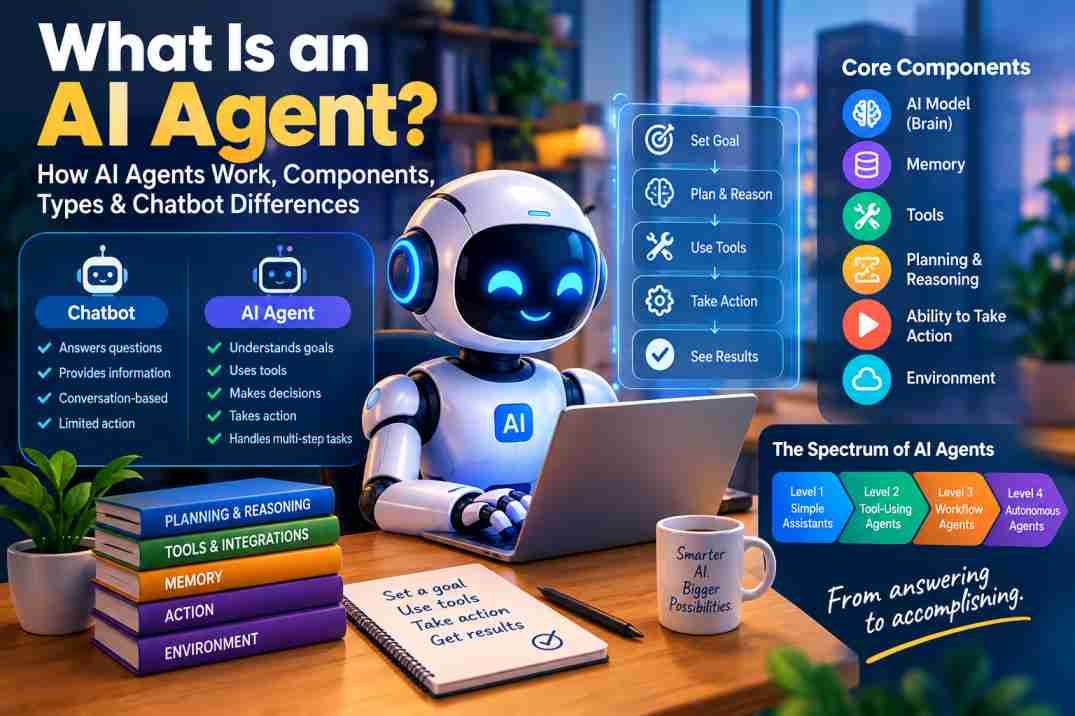
Goal → Understand → Plan → Use tools → Take action → Observe result → Adjust → Complete task
This makes AI agents particularly useful for tasks that involve multiple steps.
For example, imagine you want to organize a business meeting.
A basic Chabot might tell you:
“Here are some steps you can follow to organize the meeting.”
An AI agent could potentially:
- Check your calendar.
- Identify available dates.
- Find suitable meeting times.
- Draft an invitation.
- Send the invitation through an approved communication tool.
- Track responses.
- Update the calendar.
- Remind participants before the meeting.
The agent isn’t merely explaining how to do the work. It is designed to help perform the work. Learn what AI agents are how they differ from chatbots.
AI Agent vs. Chatbot: What’s the Difference?
The terms AI agent and AI Chabot are sometimes used interchangeably, but they do not necessarily mean the same thing.
A Chabot is primarily designed for conversation.
An agent is designed around achieving objectives and taking actions.
Traditional Chabot
A Chabot might:
- Answer questions
- Explain concepts
- Summarize information
- Generate text
- Have conversations
- Provide recommendations
Its main interface is usually a conversation.
AI agent
An AI agent may:
- Understand a goal
- Break a goal into smaller tasks
- Decide what steps to take
- Use external tools
- Access relevant information
- Execute actions
- Check results
- Recover from certain errors
- Continue working through a multi-step process
Therefore, a Chabot can be thought of as primarily response-oriented, while an agent is more goal-oriented.
However, the distinction isn’t always absolute.
A modern AI system can combine both capabilities. A chatbot can have agentic capabilities, while an agent can communicate with users through a chat interface.
The important distinction is not the appearance of the interface.
It is the system’s ability to reason, use tools, maintain context, and take actions toward a goal.
The Core Components of an AI Agent
An AI agent usually requires several important components working together.
Think of an agent as a digital worker.
Just as a human worker needs a brain, memory, information, tools, and the ability to act, an AI agent needs corresponding components.
The major components include:
- Brain
- Memory
- Tools
- Planning and reasoning
- Ability to take action
- Workspace or environment
Let’s examine each one.
1. The Brain: The AI Model
The first major component is the agent’s AI model.
This could be a large language model (LLM) or another type of machine-learning model.
The model acts as the reasoning engine that helps the agent understand instructions and determine what should happen next. Learn what AI agents are how they differ from chatbots.
For example, suppose an agent receives this instruction:
“Find the best flight options for my trip and organize them by price.”
For example:
The AI model needs to understand:
- Where the person wants to travel
- The relevant dates
- What “best” might mean
- What information needs to be collected
- How the options should be compared
- How the final result should be presented
The model provides the intelligence required to interpret the task.
But an AI model by itself isn’t necessarily an agent.
A model can generate an answer without being able to perform actions in the outside world.
This is where the other components become important.
2. Memory
An effective agent may need memory to retain relevant information.
Without memory, an AI system could struggle to maintain continuity across a long task.
Consider a customer-service agent.
A customer might initially say:
“I’m having a problem with my order.”
Later, they might explain:
“The order was supposed to arrive yesterday.”
The agent needs to connect the second statement with the original problem.
Memory can operate at different levels.
Short-term memory
This is information needed during the current task or conversation.
For example:
- The user’s current request
- Previous messages
- Current task status
- Decisions already made
Long-term memory
This can involve information that remains useful beyond a single interaction, depending on how the system is designed.
For example:
- User preferences
- Previous interactions
- Frequently used information
- Business rules
- Historical records
Memory becomes especially important when an agent performs complicated workflows.
Imagine an agent researching a company.
It might collect:
- Revenue
- Profit
- Debt
- Assets
- Market valuation
- Competitor information
The agent needs somewhere to keep this information while it continues working.
3. Tools
Tools are what allow an AI agent to interact with systems outside the AI model itself.
This is one of the most important differences between a basic conversational AI and a tool-using agent.
An agent could potentially have access to tools such as:
- Web search
- Databases
- Calculators
- Spreadsheets
- Calendar systems
- Code execution
- File systems
- Business software
- APIs
- Browsers
For example, an AI model might know how to calculate compound interest.
But if an agent needs to retrieve today’s exchange rate, it may need access to a current data source.
Similarly, an agent may know how to write an email, but it needs an email tool if it is actually going to send that email.
This creates a useful distinction:
The AI model provides intelligence. Tools provide capabilities.
4. Planning and Reasoning
Another important component of an AI agent is the ability to plan a task.
Some tasks can be completed with one action.
Others require a sequence of actions.
For example:
“Create a report about the Nigerian banking sector.”
This sounds like one request, but it can actually involve many smaller tasks:
- Identify the relevant banks.
- Gather financial information.
- Collect recent performance data.
- Compare companies.
- Analyze the data.
- Organize the findings.
- Write the report.
- Review the report for errors.
An agent capable of planning can break the larger objective into manageable steps.
This is sometimes called task decomposition.
Instead of treating the instruction as one giant problem, the agent asks:
“What needs to happen first?”
Then:
“What needs to happen after that?”
And eventually:
“Is the goal complete?”
5. Ability to Take Action
Planning alone isn’t enough.
An agent needs the ability to execute appropriate actions.
For example, imagine an AI agent managing a company’s inventory.
It could:
- Check current stock.
- Identify products that are running low.
- Review previous sales.
- Estimate future demand.
- Prepare a purchase order.
- Send it to an approved supplier.
The agent therefore moves from thinking to doing.
This is what makes agentic AI particularly interesting for businesses.
Instead of simply generating information for employees, an agent can potentially become part of the workflow itself.
6. The Workspace or Environment
An AI agent also needs an environment in which it can operate.
This might be:
- A web browser
- A computer
- A company’s internal software
- A database
- A cloud environment
- A coding environment
- A document management system
The environment provides the space where the agent can perform its tasks.
For example, a research agent may operate inside a browser.
A coding agent may operate inside a development environment.
A financial operations agent may interact with spreadsheets and accounting software.
The environment determines what the agent can see and what actions it can perform. Learn what AI agents are how they differ from chatbots.
How an AI Agent Actually Works
A simplified AI-agent workflow looks like this:
- Receive a goal
- Understand the goal
- Create a plan
- Select the appropriate tool
- Perform an action
- Observe the result
- Decide what to do next
- Repeat if necessary
- Complete the goal
This creates a feedback loop.
The agent doesn’t necessarily know every step in advance.
It can use the result of one action to determine the next action.
For example:
Suppose an agent is told:
“Find five affordable hotels for my trip.”
The agent might:
1: Determine the destination and dates.
2: Search available hotels.
3: Collect prices and relevant information.
4: Remove options that don’t satisfy the requirements.
5: Compare the remaining hotels.
6: Produce a shortlist.
If a search doesn’t return useful results, the agent may need to change its approach.
That ability to observe, adapt, and continue is central to agentic systems. Learn what AI agents are how they differ from chatbots.
The Spectrum of AI Agents
Not every AI agent is equally autonomous.
There is a spectrum ranging from relatively simple automated systems to highly capable systems that can manage complex workflows.
Level 1: Simple AI Assistants
These systems mainly respond to instructions.
Examples include:
- Question-answering assistants
- Writing assistants
- Basic customer-service bots
They may have limited tool access and little autonomy.
Level 2: Tool-Using Agents
These agents can select and use tools.
For example, they may:
- Search the web
- Calculate numbers
- Query a database
- Read files
- Retrieve information from an API
Instead of simply answering from their existing knowledge, they can obtain additional information.
Level 3: Workflow Agents
These systems can perform several connected steps.
For example:
Receive customer inquiry → Check database → Determine issue → Prepare response → Update customer record.
The important feature is that the system can complete a workflow rather than performing only one isolated action.
Level 4: Autonomous Multi-Step Agents
At a more advanced level, an agent can receive a broad objective and determine much of the process itself.
For example:
“Research the market for this product and prepare a business opportunity report.”
The agent may determine:
- What information it needs
- Where to obtain it
- What tools to use
- How to analyze the information
- How to structure the final report
The human provides the objective while the agent manages more of the execution.
AI Agents and Automation
AI agents are closely connected to automation, but they are not exactly the same thing.
Traditional automation usually follows predefined rules.
For example:
If an order is received → send confirmation email.
This is predictable and structured.
AI agents can operate in environments where the exact sequence isn’t known beforehand.
For example:
“Find customers who appear likely to cancel their subscriptions and recommend appropriate retention actions.”
There may not be one fixed sequence for every customer.
The agent may need to interpret information, make decisions, use different tools, and adapt its approach.
This is why AI agents are often described as a bridge between AI and automation. Learn what AI agents are how they differ from chatbots.
Why AI Agents Matter
The significance of AI agents goes beyond chatbots.
For decades, software has helped people perform individual tasks.
For example:
AI agents could potentially change this by allowing software to manage entire processes.
Consider the difference:
Traditional software
You operate the software.
Chatbot
You ask the AI for information.
AI agent
You give the AI a goal, and it helps execute the process. This could change how people interact with computers.
Instead of learning how to operate dozens of different applications, users may increasingly describe what they want accomplished.
For example:
“Prepare my monthly financial report.”
Instead of manually opening spreadsheets, copying information, calculating figures, creating charts, and formatting a document, an agent could potentially coordinate these steps.
AI Agents in Business
Businesses are particularly interested in AI agents because many business processes involve repetitive multi-step work.
Potential applications include:
Customer service
An agent could:
- Understand a customer’s problem
- Retrieve account information
- Search company policies
- Suggest a solution
- Escalate complicated cases
Marketing
An agent could help:
- Research audiences
- Analyze competitors
- Generate content ideas
- Organize campaigns
- Analyze campaign performance
Finance
Financial agents could potentially assist with:
- Financial reporting
- Data collection
- Expense categorization
- Research
- Forecasting
- Portfolio analysis
Human oversight remains important, especially for high-stakes financial decisions.
Software development
Coding agents can potentially:
- Understand a coding task
- Inspect existing code
- Write code
- Run tests
- Identify errors
- Modify the code
- Repeat the process
This is an excellent example of a multi-step workflow.
AI Agents in Everyday Life
Agentic AI isn’t limited to corporations.
Imagine a personal AI assistant that could help manage everyday activities.
You might say:
“Help me organize my week.”
The agent could potentially examine your calendar, identify conflicts, prioritize tasks, prepare reminders, and suggest a schedule.
Or you might say:
“Help me plan a trip within my budget.”
The agent could research transportation, accommodation, activities, costs, and organize everything into an itinerary.
For example:
The important shift is from:
“Tell me something.”
to:
“Help me accomplish something.”
What Are the Risks of AI Agents?
Greater autonomy also creates greater risks.
A chatbot that gives you a bad answer is one problem.
An agent that takes a bad action can create a much larger problem.
For example, an improperly configured agent could:
- Send the wrong email
- Modify the wrong file
- Purchase something unnecessarily
- Share confidential information
- Make an incorrect business decision
- Continue a task based on faulty information
Therefore, AI agents need safeguards.
These can include:
- Human approval
- Permission controls
- Limited tool access
- Activity monitoring
- Confirmation before sensitive actions
- Error detection
- Audit logs
The more power an agent has, the more important these controls become.
The Future of AI Agents
AI agents represent an important evolution in artificial intelligence.
The first major wave of consumer AI focused heavily on generating content and answering questions.
The next wave is increasingly focused on performing tasks.
That doesn’t mean humans will disappear from the process.
Instead, the relationship between humans and software may change.
For example:
Humans may increasingly provide:
- Goals
- Judgment
- Creativity
- Context
- Approval
- Strategic direction
While AI agents handle more:
- Research
- Information processing
- Repetitive tasks
- Coordination
- Execution
- Monitoring
The result could be a workplace where people don’t simply use AI as a tool. They work alongside AI systems capable of managing portions of larger workflows.
Final Thoughts
An AI agent is more than a chatbot with a fancy name.
At its core, an AI agent combines an AI model with memory, tools, planning, reasoning, an environment, and the ability to take actions.
A simple chatbot might answer:
“How can I research a company?”
An agent could potentially be given the objective:
“Research this company, compare its financial performance with competitors, organize the information, and prepare a report.”
That distinction—answering versus accomplishing—is one of the most important concepts to understand about the emerging agentic AI landscape.
As AI continues to evolve, the biggest opportunity may not simply be having an AI that can generate better answers.
It may be having AI systems that can take those answers and turn them into actions.
And that is where AI agents become particularly powerful.