
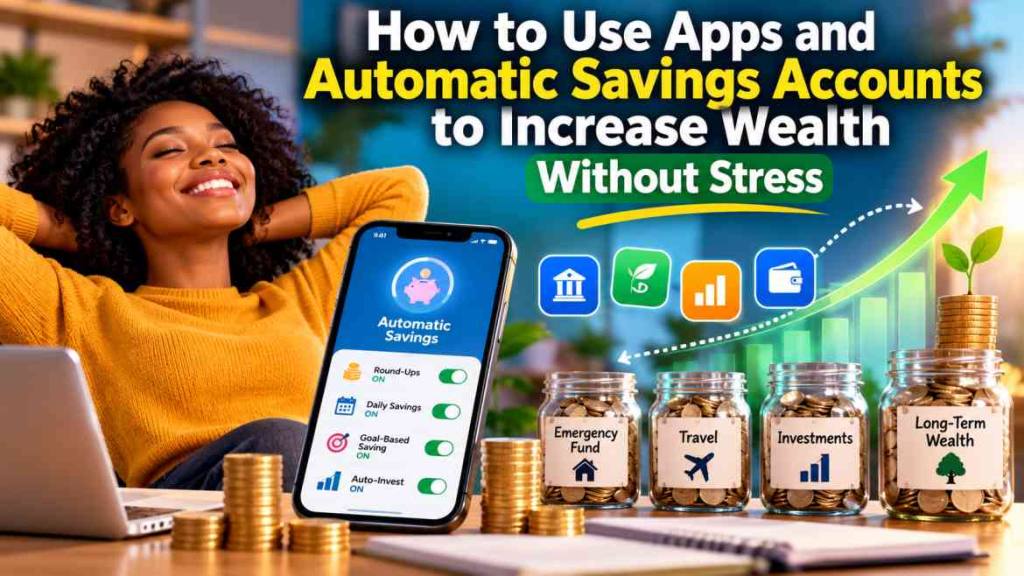
How to Use Apps and Automatic Savings Accounts to Increase Wealth Without Stress
Saving money can be difficult even when you understand its importance. You may plan to save part of every paycheck, but unexpected bills, everyday spending, and tempting purchases can interfere with your plans.
One way to make saving more consistent is to automate it.
Automatic savings tools allow you to schedule transfers, round up eligible purchases, or move money into separate accounts according to rules you choose. Instead of relying on the decision to save at the end of every month, you create a system that helps you save before the money is spent.
However, automation is not a shortcut to guaranteed wealth. Apps can charge fees, savings interest rates can change, and some automated products invest money that can lose value.
The goal is to use technology to develop better financial habits while maintaining control over your money.
1. What Is Automatic Saving?
Automatic saving is a method of regularly transferring money into savings without manually initiating every transaction.
For example, suppose you receive a paycheck of $3,000 each month. You arrange for $200 to move automatically from your checking account into a separate savings account after payday.
If you maintain that contribution for 12 months, you will have transferred $2,400 into savings, excluding interest, fees, and withdrawals.
The benefit is that saving becomes part of your financial routine rather than a decision you must make repeatedly.
Automatic saving can help you work towards several goals, including:
- Building an emergency fund.
- Saving for a home deposit.
- Preparing for a holiday.
- Paying for education or professional training.
- Setting aside money for annual bills.
- Building retirement savings.
- Creating a reserve for unexpected expenses.
You can use a bank’s existing features, a budgeting app, or a specialist savings service. The best option depends on your country, your financial goals, and the fees and protections attached to the product.
2. How Automatic Savings Accounts Work
An automatic savings arrangement usually involves a transaction account, a savings account, and a transfer rule.
Your transaction account receives your income and pays your regular expenses. Your savings account holds money you have decided not to spend immediately.
You then choose how money moves between the accounts.
Fixed automatic transfers
This is one of the simplest methods.
You choose an amount and schedule a recurring transfer. It could happen weekly, every two weeks, or monthly.
For example, transferring $75 every week would move $3,900 into savings over 52 weeks, assuming you make every transfer and do not withdraw the money.
This method works well when your income is reasonably predictable.
Percentage-based saving
Instead of choosing a fixed amount, you can decide to save a percentage of each paycheck or income payment.
For example, someone receiving $2,500 after tax might decide to save 5% of each payment.
That would mean saving $125 from that payment.
Percentage-based saving can be useful for freelancers, commission-based workers, and people whose income varies from month to month.
However, make sure you have enough money left to cover essential bills, required debt payments, and everyday expenses.
Goal-based savings spaces
Some financial institutions let you create labelled savings spaces or separate pots within an account.
You might create one for emergencies, another for travel, and another for a home deposit.
This helps you avoid treating every dollar in your savings balance as available spending money.
The feature may be available directly through your bank, so you might not need to download another app.
3. Use Round-Up Features to Save Small Amounts
Round-up savings tools transfer a small amount into savings when you make eligible purchases.
For example, suppose you spend $18.40 using a linked debit card. A round-up feature might round the transaction to $19 and transfer the additional $0.60 into savings.
If you make many eligible purchases, these small transfers can accumulate over time.
However, the total depends on your spending habits. Someone who makes fewer card purchases may accumulate very little, while a frequent card user may save more.
Related articles
- How to Save Money for Short-Term and Long-Term Goals
- The Hard Truth About Investing: What Could Go Wrong and How to Protect Yourself
- Do Life Insurance Beneficiaries Pay Taxes?
An example of round-up savings
Imagine that your round-up transfers average $1.50 per day.
Over 30 days, that would amount to approximately $45.
Over 12 months, it would amount to approximately $547.50, assuming the average remains consistent for 365 days.
This is useful progress, but it should not be confused with investment returns. Most of the money comes from your own spending, and the transfers may reduce the amount available in your transaction account.
The potential disadvantage
Round-ups are not automatically beneficial if you are spending more than you can afford.
If you buy unnecessary items simply because the app makes saving feel effortless, the additional spending could outweigh the amount you save.
A better strategy is to use round-ups on purchases you were already planning to make and review the total amount transferred each month.
Round-ups should supplement your main savings plan rather than replace it.
4. Choose the Right Savings App for Your Country
Not every savings app is available in every country. Some are restricted to residents of particular jurisdictions, and others require a specific bank account or payment card.
Before downloading an app, verify its availability, eligibility requirements, fees, and regulatory status.
United States
US consumers may be able to use automatic transfers through their existing bank, a dedicated savings app, or an investment platform.
Some services offer round-ups, recurring transfers, savings goals, or automated investing. These are different features, and it is important to understand where the money goes.
A bank savings account is different from an investment account. An investment account can expose your money to market losses.
Before opening an account, check whether the institution is appropriately regulated and whether eligible deposits receive FDIC or applicable credit union insurance.
Official resources:
FDIC — Understanding Deposit Insurance:
NCUA — Share Insurance Coverage:
United Kingdom
UK consumers can often arrange regular transfers through their bank’s mobile app or online banking service.
Some providers offer savings pots, round-ups, or automated rules that transfer money when certain conditions are met.
Before using a third-party service, check whether it holds your money, initiates transfers between accounts, or invests your money with another provider. These arrangements can have different risks and protections.
You should also check whether eligible deposits are protected by the Financial Services Compensation Scheme (FSCS) and whether the relevant provider and account qualify.
Official resource:
Financial Services Compensation Scheme:
European Union
Consumers in European Union countries may have access to automated transfers, savings spaces, and budgeting features through local banks and authorised financial service providers.
Availability and account conditions vary by country. An app that works in one EU member state may not be available to residents of another.
For eligible bank deposits, EU deposit guarantee schemes generally protect up to €100,000 per depositor, per bank, subject to the applicable rules.
However, this protection does not normally cover losses arising from investments in stocks, exchange-traded funds, or other market-based products.
Official resource:
European Commission — Deposit Guarantee Schemes:
Important: Always check the protection that applies to your specific provider and product. An app’s brand name alone does not establish that your money is protected.
5. Compare Fees Before Choosing an App
An app may advertise convenience while charging a subscription fee, account fee, investment management fee, or other transaction costs.
These charges can reduce the benefit of saving small amounts.
Imagine an app charges $3 each month for a feature that helps you save $20 monthly through round-ups.
The annual fee would be $36, while your annual round-up transfers would total $240 if the pattern remained unchanged.
That fee would consume 15% of the amount transferred through round-ups.
This does not necessarily mean the app is unsuitable. It means you should assess whether the features justify the cost.
Before signing up, check:
- Monthly or annual subscription charges.
- Account maintenance fees.
- Transfer or withdrawal fees.
- Investment management fees.
- Minimum balance requirements.
- Charges for moving money between providers.
- Whether the advertised features require a paid plan.
If your bank already provides automatic transfers for free, a separate paid app may offer little additional value.
6. Automate Your Savings Without Causing Overdrafts
One common mistake is scheduling automatic transfers without considering the timing of income and bills.
Suppose your rent is due on the first day of the month and your paycheck arrives on the third. If your automatic savings transfer occurs before rent is paid, you may leave insufficient money in your account.
Depending on your account terms, this could lead to an overdraft, a declined payment, or a fee.
To avoid this problem, follow a simple sequence:
- Identify when your income arrives.
- List essential bills and their due dates.
- Decide how much you can safely save.
- Schedule transfers after sufficient funds are available.
- Keep an appropriate buffer for unexpected expenses.
- Review your account balance regularly.
You can also set alerts for low balances or failed transfers if your bank offers them.
Automation should reduce financial stress, not create new problems.
If your income is irregular, consider using a percentage of each payment or making transfers manually when your balance is sufficient.
7. Use Separate Savings Goals to Stay Organised
Saving for several goals in one account can make it difficult to know how much you can afford to spend.
Suppose you have $5,000 in savings. That amount may seem substantial, but if $3,000 is reserved for an upcoming home expense and $1,500 is your emergency fund, only $500 is unallocated.
Labelling your savings helps prevent you from spending money intended for another purpose.
You could organise your savings into these categories:
Emergency fund: Money for unexpected expenses or an interruption to income.
Short-term purchases: Money for holidays, household equipment, or annual bills.
Medium-term goals: Money for a property deposit, education, or another major expense.
Long-term goals: Money intended for retirement or other objectives many years away.
For each goal, set a target amount and a deadline. Then calculate the regular contribution required to reach it.
For example, if you need $1,200 in 12 months and have not saved anything towards the goal, you would need to contribute $100 each month, excluding interest and fees.
This calculation gives you a clear target to build into your automated plan.
8. Do Not Confuse Automatic Saving With Automatic Investing
Some financial apps move money into a bank savings account. Others use your money to purchase investments.
The distinction matters because savings and investing have different purposes and risks.
Automatic saving
Automatic saving generally involves moving money into an account designed to hold cash.
Depending on the account, your money may earn interest, and eligible deposits may benefit from applicable deposit protection.
This approach may be appropriate for emergency funds and goals that require relatively stable balances.
Automatic investing
Automatic investing involves regularly purchasing assets such as stocks, bonds, or exchange-traded funds.
This can help you develop a consistent investing habit, but the value of your holdings can rise or fall.
An investment account should not be treated as a guaranteed savings account. Investment products generally do not receive the same deposit protection as eligible bank deposits.
Before automating investments, understand:
- What assets the app will purchase.
- Whether your money is invested immediately.
- The investment fees and transaction costs.
- The risks associated with the portfolio.
- Whether you can change or cancel recurring purchases.
- Whether the provider is authorised to offer the service in your jurisdiction.
Long-term investing may have a place in a financial plan, but money needed soon should not automatically be exposed to market risk.
For more information, see Investor.gov’s guide to investing:
9. How to Build an Automatic Savings Plan in 30 Days
You do not need to set up every available feature at once. Start with a simple system and improve it gradually.
Week 1: Review your finances
List your income, essential bills, debt payments, subscriptions, and everyday spending.
Work out how much you can save without putting essential payments at risk.
If your expenses exceed your income, focus first on understanding the shortfall and identifying realistic changes.
Week 2: Choose your savings goals
Select one or two priorities.
For example, you might start with an emergency fund and a planned annual expense.
Set a target amount for each goal and calculate the contribution required to reach it.
Week 3: Set up automation
Check whether your current bank offers recurring transfers or separate savings spaces.
If you decide to use another app, compare its fees, account conditions, security arrangements, and regulatory status.
Begin with an affordable transfer rather than committing to an amount that may be difficult to maintain.
Week 4: Review the results
Check whether the transfers occurred as expected.
Confirm that your essential bills were paid, no unnecessary fees were charged, and the savings balance matches your plan.
If the transfers were too large, reduce them. If you had a comfortable surplus, consider increasing your contributions.
The purpose of the first month is to create a system that works reliably.
10. Common Automatic Savings Mistakes to Avoid
Saving too much too soon
A large transfer may look impressive, but it can leave you short of money for essential expenses.
Start with a sustainable amount and increase it when your budget allows.
Ignoring expensive debt
If you have high-interest credit-card debt, the interest charges may exceed what you earn from ordinary savings.
You may need to balance emergency savings with a plan to repay expensive debt rather than sending every available dollar into savings or investments.
Leaving money in an account that pays little interest
A convenient account may not offer a competitive rate.
Compare the interest rate, access restrictions, and fees periodically, especially if you are holding a substantial cash balance.
Forgetting about inflation
Inflation reduces purchasing power over time. Even if your account balance grows, the money may buy less in the future.
For long-term goals, consider whether cash savings alone are suitable for your circumstances.
Paying for unnecessary app features
A premium subscription may not be worthwhile if you only need a recurring transfer.
Check what your existing bank offers before paying for another service.
Assuming an app is automatically safe
A professional-looking interface does not prove that a provider is regulated or that your money is protected.
Research the provider, read the terms, and verify the relevant protections before transferring money.
11. Frequently Asked Questions
Do automatic savings apps really help you save money?
They can help by reducing the number of decisions you need to make and creating a consistent savings routine. However, the amount you save depends on your income, expenses, contribution settings, and withdrawals.
Are round-up savings enough to build wealth?
Round-ups can help you accumulate small amounts, but they are usually best treated as a supplement to regular savings. For substantial goals, a planned recurring contribution may provide more predictable progress.
Is it better to use my bank’s savings feature or a separate app?
Start by checking your bank’s existing features. If they meet your needs without additional fees, you may not need a separate service. A specialist app may be useful if it offers features you genuinely need and its costs and risks are reasonable.
Are savings apps safe?
Safety depends on the provider, how the service holds or transfers money, the security measures used, and the protections applicable to the account. Verify these details before signing up.
Can I automate investing for retirement?
Some providers allow recurring investments into retirement accounts or investment portfolios. Whether this is suitable depends on your financial situation, risk tolerance, tax position, and the account’s rules.
How much should I automate each month?
There is no universal amount. Start with what you can afford after accounting for essential bills, required debt payments, and an appropriate cash buffer. You can increase the contribution as your financial position improves.
Conclusion: Let Technology Support Your Financial Habits
Automatic savings tools can make it easier to build a financial reserve, prepare for major purchases, and develop consistent money habits.
You do not need several apps or complicated rules to get started. A separate savings account and a recurring transfer may be enough.
Begin by choosing a realistic savings target, checking the fees and protections associated with your account, and scheduling transfers that fit your income.
As your financial circumstances change, review the system and adjust it accordingly.
The real benefit of automation is not that an app makes you wealthy by itself. It is that a well-designed system can help you save consistently, protect money for important goals, and make more deliberate financial decisions over time.
Financial Disclaimer
This article is for educational and informational purposes only. It is not personalised financial, investment, tax, or legal advice. App availability, fees, deposit protection, investment rules, and tax treatment vary by country and provider and can change. Check current terms and official regulatory guidance before making financial decisions.
Related articles:
- The Hard Truth About Investing – What Could Go Wrong and How to Protect Yourself
- Do Life Insurance Beneficiaries Pay Taxes?
- Strategies for Repaying Your Life Insurance Loan
- How to Find Life Insurance Brokers Near Me
- how to save money for short term and long term goals
- Dangote Oil Shares: Complete Guide to Dangote Refinery IPO
